

Trips and neurotransmitters: Discovering principled patterns across 6850 hallucinogenic experiences (Ballentine, et al 2023)
The dominant factor spanned a continuum of experiential facets whose opposite extreme flagged words that appear to describe mental expansion, including the terms universe, space, world, consciousness, breakthrough, existence, earth, dimension, reality, flame, and tunnel—all of which would be consistent with the phenomenology of the mystical experience (3). References to liminal conscious beings, also characteristic of the mystical experience, were described by the terms entity, sitter, alien, beings, and spirit. A theme of immediate time horizon was indicated by the term seconds and also suggested by references to bodily systems such as eyes and lungs, along with physiological functions inhale(d), exhaled, and breath. At the level of neurotransmitter receptors, this constellation of induced conscious alterations was linked most strongly with drugs that preferentially bind to D1, 5-HT7, KOR, 5-HT5A, as well as Sigma-1 and NMDA. The codependencies embedded in this profile of receptor bindings and subjective terms were most closely associated with the hallucinogenic drugs DMT, salvinorin A, 5-MeO-DMT, and ketamine. The anatomical brain regions that coexpress these sets of receptor density proxies included some of the highest regions of the association cortex, especially the rostral and dorsal anterior cingulate cortex, temporoparietal junction, and also prominently in the primary motor and sensory cortices.
Case report: Adult with bipolar disorder and autism treated with ketamine assisted psychotherapy (Harris, et al, 2024)
This case study adds to the scant literature regarding ketamine treatment for individuals with bipolar disorder and ASD. We did not find ASD to be a contraindication for IV ketamine and ketamine assisted psychotherapy. Reductions in anger outbursts, anxiety, suicidality, and depression suggest ketamine treatment might be tailored to individuals with bipolar disorder and ASD, and additional systematized research is warranted. Although potential mechanisms of action are not clear, these data add to the discussion regarding clinical practice considerations and the potential for ketamine to improve quality of life and associated metrics.
Ketamine-assisted psychotherapy, psychedelic methodologies, and the impregnable value of the subjective—a new and evolving approach (Wolfson & Vaid, 2024)
Psychiatry is in a growth phase in which several psychedelic medicines have entered its arena with great promise. Of these, presently, ketamine is the only medicine that may be legally prescribed. We hypothesize that at subanesthetic doses, ketamine produces a unique spectrum of altered states, ranging from psychoactive to deep ego-dissolving experiences, that are intrinsic to ketamine’s therapeutic effects. When these experiences are embedded in a therapeutic relationship—a setting—that fosters an amplification of the recipient’s subjective consciousness, personal growth, inner healing, greater clarity, and better relationships may well ensue. While much of the literature on ketamine labels its dissociative effects as ‘side effects’, alteration of consciousness is a component and unavoidable ‘effect’ of its therapeutic impact. From its inception in the clinical trials of the 1960s, ketamine was recognized for producing dissociative, psychedelic effects on consciousness in subjects as they emerged from ketamine-induced anesthesia. Unanticipated and unintegrated, these experiences of ‘emergence phenomena’ were felt to be disturbing. Accordingly, such experiences have been typically labeled as dissociative side effects. However, in a conducive set and settings, these experiences have been demonstrated to be of positive use in psychiatry and psychotherapy, providing a time-out from usual states of mind to facilitate a reshaping of self-experience along with symptomatic relief. In this way, ketamine-assisted psychotherapy (KAP) offers a new potential in psychiatry and psychotherapy that is powerfully valanced toward recognizing experience, individuality, and imagination. Essential to a successful therapeutic experience and outcome with KAP is close attention to the subjective experience, its expression by the recipient and integration of the ketamine experience as a healing opportunity.
A unified model of ketamine's dissociative and psychedelic properties (Marguilho, et al, 2023)
Ketamine is an N-methyl-d-aspartate antagonist which is increasingly being researched and used as a treatment for depression. In low doses, it can cause a transitory modification in consciousness which was classically labelled as 'dissociation'. However, ketamine is also commonly classified as an atypical psychedelic and it has been recently reported that ego dissolution experiences during ketamine administration are associated with greater antidepressant response. Neuroimaging studies have highlighted several similarities between the effects of ketamine and those of serotonergic psychedelics in the brain; however, no unified account has been proposed for ketamine's multi-level effects - from molecular to network and psychological levels. Here, we propose that the fast, albeit transient, antidepressant effects observed after ketamine infusions are mainly driven by its acute modulation of reward circuits and sub-acute increase in neuroplasticity, while its dissociative and psychedelic properties are driven by dose- and context-dependent disruption of large-scale functional networks. Computationally, as nodes of the salience network (SN) represent high-level priors about the body ('minimal' self) and nodes of the default-mode network (DMN) represent the highest-level priors about narrative self-experience ('biographical' self), we propose that transitory SN desegregation and disintegration accounts for ketamine's 'dissociative' state, while transitory DMN desegregation and disintegration accounts for ketamine's 'psychedelic' state. In psychedelic-assisted psychotherapy, a relaxation of the highest-level beliefs with psychotherapeutic support may allow a revision of pathological self-representation models, for which neuroplasticity plays a permissive role. Our account provides a multi-level rationale for using the psychedelic properties of ketamine to increase its long-term benefits
A qualitative and quantitative account of patient’s experiences of ketamine and its antidepressant properties (Sumner, et al, 2021)
Greater antidepressant response (reduction in Montgomery-Asberg Depression Rating Scale at 24 h) correlated with the 11-dimension altered states of consciousness dimensions: spirituality, experience of unity, and insight. The first qualitative interview revealed that all participants experienced perceptual changes. Additional themes emerged including loss of control and emotional and mood changes. The final interview showed evidence of a psychedelic afterglow, and changes to perspective on life, people, and problems, as well as changes to how participants felt about their depression and treatments.Conclusions:
The current study provides preliminary evidence for a role of the psychedelic experience and afterglow in ketamine’s antidepressant properties. Reflexive thematic analysis provided a wealth of information on participants’ experience of the study and demonstrated the psychedelic properties of ketamine are not fully captured by commonly used questionnaires.
Ketamine and serotonergic psychedelics: An update on the mechanisms and biosignatures underlying rapid-acting antidepressant treatment (Johnston, et al, 2023)
The discovery of ketamine as a rapid-acting antidepressant spurred significant research to understand its underlying mechanisms of action and to identify other novel compounds that may act similarly. Serotonergic psychedelics (SPs) have shown initial promise in treating depression, though the challenge of conducting randomized controlled trials with SPs and the necessity of long-term clinical observation are important limitations. This review summarizes the similarities and differences between the psychoactive effects associated with both ketamine and SPs and the mechanisms of action of these compounds, with a focus on the monoaminergic, glutamatergic, gamma-aminobutyric acid (GABA)-ergic, opioid, and inflammatory systems. Both molecular and neuroimaging aspects are considered. While their main mechanisms of action differ-SPs increase serotonergic signaling while ketamine is a glutamatergic modulator-evidence suggests that the downstream mechanisms of action of both ketamine and SPs include mechanistic target of rapamycin complex 1 (mTORC1) signaling and downstream GABAA receptor activity. The similarities in downstream mechanisms may explain why ketamine, and potentially SPs, exert rapid-acting antidepressant effects. However, research on SPs is still in its infancy compared to the ongoing research that has been conducted with ketamine. For both therapeutics, issues with regulation and proper controls should be addressed before more widespread implementation.
Ketamine-assisted psychotherapy treatment of chronic pain and comorbid depression: a pilot study of two approaches (Batievsky, et al, 2023)
All participants’ symptoms declined throughout treatment. Psychedelic treatment participants saw a larger, more consistent decrease. Researchers conclude that KAPT may be effective for treating chronic pain/MDD comorbidity, anxiety and Post-Traumatic Stress Disorder (PTSD). Findings imply that the psychedelic approach may be more effective. This pilot study serves as a basis for more extensive research that will inform how clinicians administer treatment to optimize outcomes.
Pharmacotherapy and Ketamine Assisted Psychotherapy for Treatment-Resistant Depression: A Patient With Lifelong Self-Doubt and Self-Criticism (Yeung, et al, 2023)
Ketamine, an NMDA receptor antagonist, is not considered a classic psychedelic. Yet, it has similar dissociative effects that have been observed to bring relief from negativity, increase openness, promote communication, provide access to difficult materials with less fear, offer relief from obsessive and depressive concerns, and integrate a sense of newness and healing.19 These properties make ketamine an excellent candidate for PAP, and, currently, ketamine is the only legal psychedelic medicine available to mental health providers for the treatment of TRD. Ketamine assisted psychotherapy (KAP) has been used for patients suffering from a variety of disorders, including MDD, PTSD, bipolar I and II disorder, obsessive-compulsive disorder (OCD), and substance use. While the literature on KAP is small, it shows promise as a novel intervention to be explored further in many treatment-resistant clinical conditions.23 Similar to PAP, KAP clinicians meet with patients for 1–3 preparatory sessions to educate them about potential effects of ketamine, inform them about what happens during medication sessions and how best to engage in treatment, and guide them to select the psychological issues they want to focus on during medication treatment. In the first session, ketamine is usually given at a low sublingual dose to gauge the patient’s response, such as emotional changes, access to memories, or gaining new insights. In subsequent ketamine sessions, the doses will be titrated to optimize the patient’s therapeutic outcomes, which are frequently related to the levels of consciousness change. The therapists will then meet with the patient for “integration” sessions to process their experience in the ketamine sessions, as well as generate meanings and insights to be integrated into their cognitive framework.
Ketamine as Psychoplastogen
Ketamine’s Role in Spirituality: How One Synthetic Drug Catalyzes a Natural Experience (Woods, 2020)
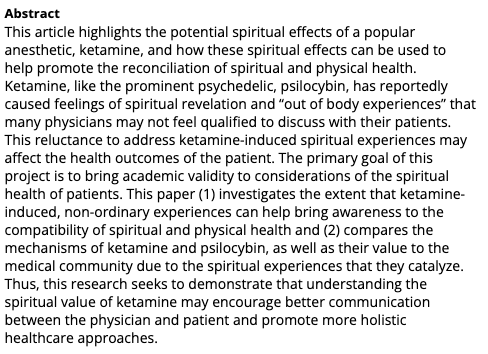
This article highlights the potential spiritual effects of a popular anesthetic, ketamine, and how these spiritual effects can be used to help promote the reconciliation of spiritual and physical health. Ketamine, like the prominent psychedelic, psilocybin, has reportedly caused feelings of spiritual revelation and “out of body experiences” that many physicians may not feel qualified to discuss with their patients. This reluctance to address ketamine-induced spiritual experiences may affect the health outcomes of the patient. The primary goal of this project is to bring academic validity to considerations of the spiritual health of patients. This paper (1) investigates the extent that ketamine-induced, non-ordinary experiences can help bring awareness to the compatibility of spiritual and physical health and (2) compares the mechanisms of ketamine and psilocybin, as well as their value to the medical community due to the spiritual experiences that they catalyze. Thus, this research seeks to demonstrate that understanding the spiritual value of ketamine may encourage better communication between the physician and patient and promote more holistic healthcare approaches.
Ketamine-Assisted Psychotherapy Provides Lasting and Effective Results in the Treatment of Depression, Anxiety, PTSD at 3 and 6 Months: Large Retrospective Effectiveness Study (Yermus, 2024)
KAP produced sustained reductions in anxiety, depression, and PTSD, with symptom improvement lasting well beyond the duration of dosing and integration sessions. These effects extended to as much as 5 months after the last KAP session. However, the high rates of attrition may limit validity of the results. Given the growing mental health care crises and the need for effective therapies and models of care, especially for intractable psychiatric mood-related disorders, these data support the use of KAP as a viable alternative. Further prospective clinical research should be undertaken to provide evidence on the safety and effectiveness of ketamine within a psychotherapeutic context.
Psychedelic assisted therapy for major depressive disorder: Recent work and clinical directions (McCartney, 2022)
This review has examined the psychedelic treatment of MDD from a multifactorial perspective. A comparison of recent clinical trials shows that the psychological component of psychedelic treatment is vital for sustaining antidepressant outcomes. This aligns with the emerging biological understanding of these substances, specifically, their capacity to induce a period of neural plasticity that enhances the opportunity for emotional, cognitive, and behavioural repatterning. Given the bias towards a medical treatment model caused by the socio-political history of psychedelics, as well as flat out ignorance of their longstanding medicinal uses in cultures across the world, future research would benefit from more deliberately considering the importance of combined psychological and psychedelic therapy. Arguably, as these substances become increasingly legalised in a medical context, and thereby accessible to the public, psychedelic therapy will become less stigmatised. Until then, acknowledgment in clinical research and by practitioners of the dual importance of biological and psychological factors, could help to present a united front that actively works to align public perception of psychedelic treatment with its true therapeutic potential.

Ketamina no parenteral para la depresión: una discusión práctica sobre el potencial de adicción y recomendaciones para una prescripción juiciosa (Swainson, et al, 2022)
La ketamina sublingual es más biodisponible (30%) que la ketamina oral (20%). Un estudio reciente describió la seguridad y eficacia de la ketamina intravenosa a dosis de 0,5 mg/kg y 1,0 mg/kg y ningún beneficio para dosis más bajas. Esto se traduce en 1,5 o 3,0 mg/kg si se administra por vía sublingual, y 2,5 o 5,0 mg/kg si se administra por vía oral. Con esto en mente, solo 24,5 de los 7 estudios retrospectivos de la revisión sistemática incluyeron pacientes con ketamina en dosis adecuadas. Todos los demás estaban por debajo de las dosis equivalentes esperadas de SL y orales. Dos estudios prospectivos también administraron una dosis insuficiente de ketamina a dosis de 25 mg dos veces al día o 0,5 mg/kg al día, y un estudio prospectivo utilizó una dosis diaria total potencialmente adecuada de 50 mg tres veces al día, pero las dosis divididas pueden haber contribuido a una respuesta de ketamina reducida o más lenta.
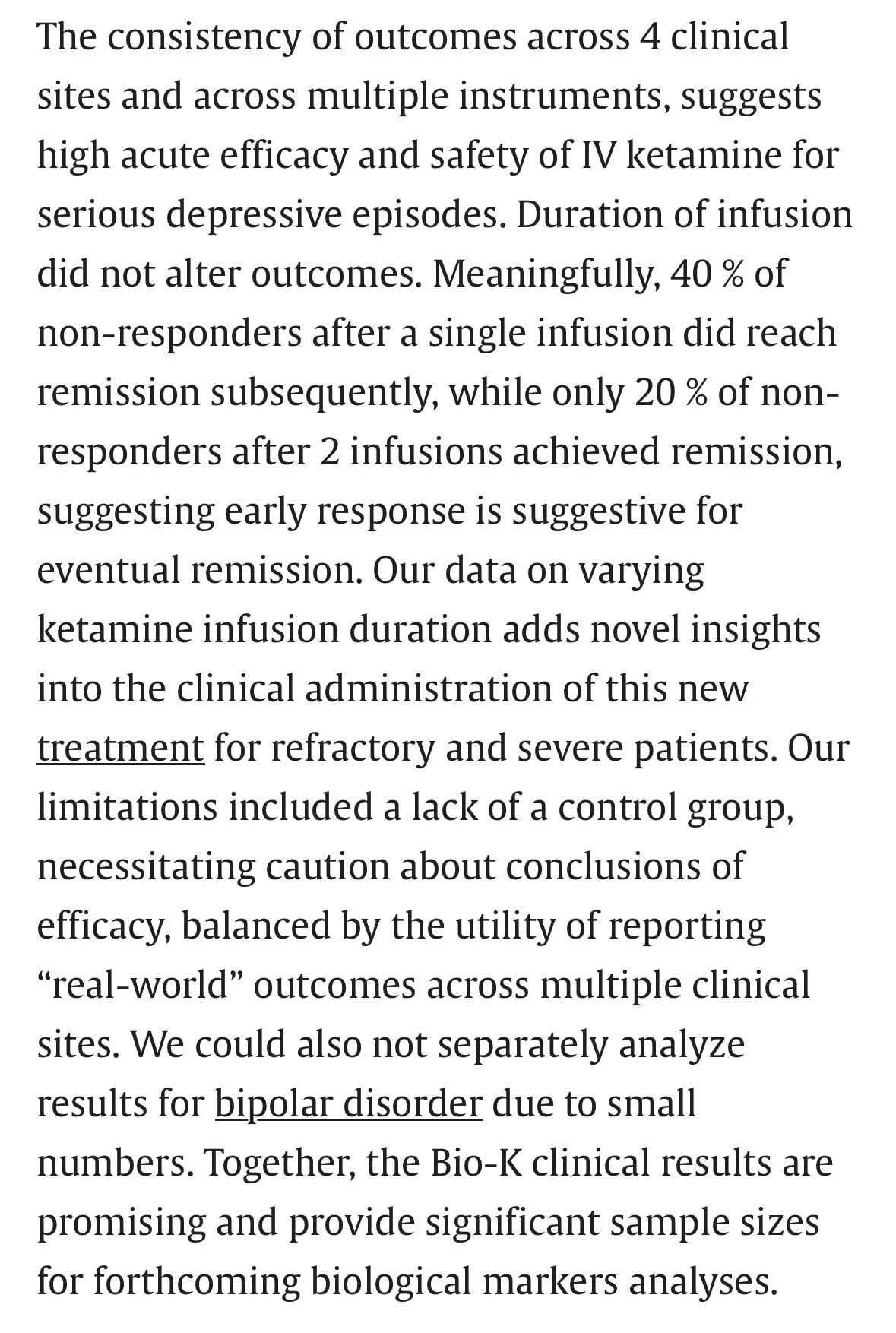
Clinical outcomes in the biomarkers of ketamine (Bio-K) study of open-label IV ketamine for refractory depression (Parikh, et al, 2024)
Resultados clínicos del tratamiento con ketamina intravenosa para la depresión en el sistema de salud VA (Pfeiffer, et al, 2024)
Intravenous (IV) ketamine is effective for reducing symptoms of major depressive disorder in short-term clinical trials; this study characterized clinical outcomes of repeated infusions in routine clinical practice and the frequency and number of infusions used to sustain symptom improvement. Methods: Records of IV ketamine infusions for depression and associated Patient Health Questionnaire-9 (PHQ-9) scores were identified from Veterans Health Administration (VA) electronic medical records for patients treated in Fiscal Year 2020 and up to 12 months following the date of their first infusion. Results: Sample patients (n = 215) had a mean baseline PHQ-9 score of 18.6 and a mean of 2.1 antidepressant medication trials in the past year and 6.1 antidepressant trials in the 20 years prior to their first ketamine infusion. Frequency of infusions decreased from every 5 days to every 3–4 weeks over the first 5 months of infusions, with a mean of 18 total infusions over 12 months. After 6 weeks of treatment, 26% had a 50% improvement in PHQ-9 score (response) and 15% had PHQ-9 score ≤ 5 (remission). These improvements were similar at 12 and 26 weeks. No demographic characteristics or comorbid diagnoses were associated with 6-week PHQ-9 scores. Conclusions: While only a minority of patients treated with IV ketamine for depression experienced response or remission, symptom improvements achieved within the first 6 weeks were sustained over at least 6 months with decreasing infusion frequency. Further study is needed to determine optimal infusion frequency and potential for adverse effects with repeated ketamine infusions for depression. J Clin Psychiatry 2024;85(1):23m14984 Author affiliations are listed at the end of this article.